Choosing a coffee machine involves more than comparing prices and pressure ratings. A café machine may fill dozens of cups each hour, while a home machine usually serves a few drinks before breakfast. The difference appears in heat stability, water capacity, workflow, cleaning, and long-term reliability.
What is the difference between commercial and home coffee machines? Commercial models often use larger boilers, stronger pumps, and professional steam wands. These features support continuous brewing and faster service. Home machines are generally smaller, quieter, and easier to place beside a kettle or refrigerator. However, compact design can limit recovery time when several coffees are prepared together.
Real-world use makes these differences clearer. A barista may steam milk while extracting espresso, using a machine built for repeated movement. At home, a user might wait thirty seconds between drinks and prefer simpler controls. That choice is not inferior. It reflects a different routine.
Still, specifications can mislead. A high bar rating does not automatically create better espresso. Grind size, water quality, freshness, and technique matter greatly. Even experienced users sometimes blame the machine too quickly. This guide compares the top ten differences through practical performance, manufacturer guidance, maintenance needs, and daily operating costs. It also considers noise, safety features, installation demands, and repair access. The goal is not to declare one category universally superior. It is to identify which machine matches the volume, skill level, space, and expectations of the person using it. Small details often decide the experience.
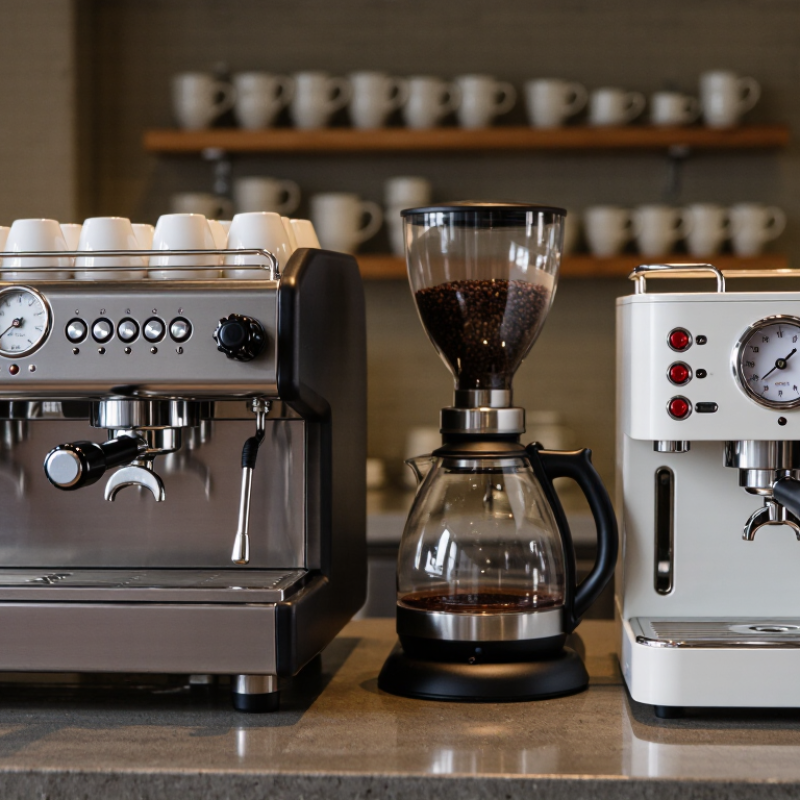
Commercial and home coffee machines differ most clearly when capacity and heating are tested under pressure. SCA brewing guidance commonly references a 7–9 gram dose for a single espresso and a 20–30 second extraction. These figures give baristas a practical starting point, not a rigid promise. In a busy café, several shots may run within minutes. A commercial machine must maintain stable water temperature and pressure during that rush.
A home machine usually handles one or two drinks at a time. Its smaller boiler or thermoblock can heat quickly, but recovery may slow after steaming milk. I notice this when the second latte produces weaker steam and a cooler cup. That delay matters. A commercial boiler stores more heated water, while stronger heating elements restore temperature faster between shots. The trade-off is greater energy use, heat, and maintenance.
Dose and timing still need adjustment. Grind size, coffee freshness, basket depth, and room temperature can shift a 20-second shot dramatically. I have followed the numbers too closely and produced a thin, sharp espresso. The lesson was uncomfortable: consistency needs judgment. A home machine may deliver excellent results with patient pacing, while a commercial unit protects workflow through larger capacity and faster boiler recovery. Recovery is the quiet difference. You feel it in the next cup.
Commercial and home coffee machines may share familiar controls, but extraction reveals their deeper differences. In a busy café, a pump may exceed 9 bar. An expansion valve can hold brewing pressure near 9 bar. That distinction matters. Pressure alone does not guarantee quality. Freshly ground coffee, even tamping, and a level puck still control flow. I check pressure at the group during brewing, not only on the gauge. A home machine may show an attractive reading but lose stability after several shots. Commercial equipment usually has larger boilers, stronger heating systems, and heavier brewing groups. Bigger is not always better.
Espresso water should generally reach 90.5–96°C at the coffee bed. Commercial machines often maintain this range more consistently during repeated service. A compact home unit may recover slowly when its boiler or reservoir is small. The first cup can taste excellent. The fourth may expose weak heat recovery. Electrical power also changes performance. A 120 V machine may draw less power and heat more slowly under demand. A 240 V system can support faster recovery, but only with compatible wiring and protection. Voltage must match the local supply. Use a properly rated circuit and follow qualified installation guidance. Power alone does not create better espresso. Insulation, sensors, boiler design, and water delivery matter too. I still question my assumptions. One test shot can mislead me. Reliable evaluation requires several shots, measured temperature, pressure, and consistent coffee preparation.
Top 10 Differences Between Commercial and Home Coffee Machines
Water affects both flavor and equipment life, but commercial machines face greater daily pressure. The Specialty Coffee Association commonly places brewing water between 75 and 250 ppm TDS. This range describes dissolved minerals, not cleanliness. Very low TDS water can taste flat and may reduce useful buffering. Very high TDS water can create scale, dull flavors, and restrict narrow passages.
The machine also needs a suitable water system. A home unit may use a removable tank, while a commercial unit often connects to treated plumbing. Filters should reduce harmful scale without stripping every mineral. A small café should test incoming water, not guess from taste. Test it at the machine inlet. Readings can change during the year. That detail is easy to miss.
Safety involves more than a clean reservoir. NSF/ANSI 4 addresses commercial cooking, baking, and food-service equipment requirements, including sanitation-related design and construction. It does not mean every coffee machine meets the standard. Operators should verify the actual certification and installation instructions. Commercial systems also need backflow protection, safe drainage, and serviceable internal parts. Home users often overlook stagnant water overnight. I have seen good water ruined by neglected tanks and old tubing. The lesson is uncomfortable: water treatment cannot replace cleaning, testing, or careful maintenance.
| No. | Water-System Dimension | Typical Home Coffee Machine | Typical Commercial Coffee Machine | Relevant Water or Safety Consideration |
|---|---|---|---|---|
| 1 | Water Supply | Manual fill Usually uses a removable reservoir filled with treated or potable water. |
Plumbed or high-capacity Commonly connected to a potable-water line, with an optional reservoir on some smaller units. |
A plumbed system should include suitable shutoff access and protection against leaks or backflow where required by local plumbing rules. |
| 2 | Daily Water Demand | Low to moderate Often sized for intermittent brewing and a relatively small number of cups per day. |
High and continuous Designed for repeated brewing, beverage production, and frequent steam or hot-water use. |
Higher throughput increases the importance of water-line sizing, filtration capacity, scale control, and scheduled maintenance. |
| 3 | Target TDS | Aim for balanced water Water within the SCA brewing range can support consistent extraction when other minerals are appropriately balanced. |
Controlled and monitored Water treatment is often selected to keep incoming water stable across high daily usage. |
The Specialty Coffee Association commonly cites approximately 75–250 ppm TDS as a broad brewing-water range. TDS alone does not identify the specific minerals present. |
| 4 | Hardness and Scale Risk | Usually less exposure Lower usage may delay scale buildup, but hard water can still damage boilers, valves, and heating elements. |
Higher exposure Large water volumes can accelerate scale formation and reduce heating or flow performance. |
Calcium and magnesium hardness—not TDS by itself—are major contributors to scale. Treatment should be based on a water test and the equipment’s specifications. |
| 5 | Filtration and Treatment | Simple filtration May use a basic carbon filter, an in-tank cartridge, or no dedicated filter. |
Engineered treatment May use sediment filtration, carbon filtration, scale reduction, reverse osmosis, or blending, depending on the water profile. |
Carbon filtration can reduce chlorine and some tastes or odors, while reverse osmosis reduces many dissolved minerals. Treatment claims must match the filter’s certified performance. |
| 6 | Mineral Balance | Often unmanaged Users may focus on total hardness or taste without measuring alkalinity, calcium, or magnesium separately. |
More deliberately managed Water may be blended or remineralized to balance flavor, corrosion control, and equipment protection. |
A useful brewing-water assessment considers TDS, hardness, alkalinity, pH, and disinfectant levels. Excessively softened or demineralized water may produce flat flavor or increase corrosion risk. |
| 7 | Boiler and Heating System | Compact thermoblock, single boiler, or small dual-temperature system is common. | Higher thermal capacity Often uses larger boilers, multiple heating circuits, or stronger recovery capability for simultaneous brewing and steaming. |
Greater thermal capacity requires reliable pressure control, temperature protection, insulation, and maintenance procedures to reduce burn and scald hazards. |
| 8 | Sanitation and Drainage | User-maintained Reservoirs, drip trays, brew paths, and removable parts are commonly cleaned manually. |
Designed for routine service May include fixed drains, larger waste capacity, accessible cleaning points, and documented cleaning schedules. |
Standing water and warm internal areas can support microbial growth. Cleaning, rinsing, descaling, and filter replacement should follow the equipment and treatment-system instructions. |
| 9 | Food-Equipment Safety Requirements | Household use Safety evaluation and installation expectations may differ from those for foodservice equipment. |
Foodservice environment Commercial equipment may be evaluated against applicable sanitation, construction, electrical, plumbing, and workplace requirements. |
NSF/ANSI 4 covers commercial cooking, reheating, and powered hot-food-holding equipment. It is not a universal certification for every coffee machine or every water treatment component; the applicable standard depends on the product and jurisdiction. |
| 10 | Monitoring and Maintenance | Periodic checks Users may check taste, filter status, visible scale, and basic TDS or hardness readings. |
Documented program Operators commonly track filter life, water quality, cleaning, descaling, leak checks, and service intervals. |
A TDS meter can identify changes in dissolved solids but cannot confirm microbiological safety or reveal the exact mineral composition. Potable water, proper sanitation, and compliance with local requirements remain essential. |
Technical note: The SCA range of 75–250 ppm TDS is a broad brewing-water guideline, not a guarantee of flavor or equipment safety. Water chemistry, treatment design, machine instructions, and applicable local regulations should be evaluated together.
Commercial and home coffee machines differ most in how they handle repeated work. A commercial unit may run hundreds of brewing cycles during a busy shift. Its boilers, pumps, and internal heating systems are built for sustained demand. A home machine usually works in shorter bursts, with longer cooling periods between drinks. The difference is rhythm.
In a café, I have seen workflow improve when dosing, extraction, and steaming follow a repeatable sequence. A grinder can deliver a timed dose, while a scale or built-in sensor checks the coffee weight. Programmable volumes also reduce manual variation between operators. Small changes still matter. A half-gram error can alter flow, strength, and waste. Automation helps, but it does not replace calibration or training. Staff still need to distribute grounds evenly, lock the handle correctly, and watch the first seconds of extraction.
Commercial machines often connect several tasks in one station. One person can brew espresso while another textures milk and prepares cups. This saves movement and protects service speed. Home users may prefer hands-on control, even when it takes longer. That choice has value. I have also found that automation can hide problems, such as a drifting grinder or blocked screen. Regular cleaning, dose checks, and temperature records remain necessary. My own workflow is not perfectly consistent, especially during rushed service. That weakness is useful to notice. It shows where equipment supports skill, and where it merely covers mistakes.
Build and Workflow: Commercial Duty Cycles, Dosing Precision, and Automation
The chart compares typical non-brand-specific operating characteristics. Commercial machines are designed for higher daily volume, tighter dosing control, and more automated workflow support, while home machines prioritize compactness, lower energy use, and occasional brewing.
Cleaning separates a convenient coffee maker from a dependable working appliance. SCA hygiene guidance emphasizes regular cleaning of food-contact surfaces, brewing paths, and milk systems. Commercial machines usually need daily backflushing, group-head cleaning, and careful steam-wand sanitation. Home machines often receive less attention. Owners may rinse the portafilter and forget the internal water path. That small habit can affect taste, odor, and hygiene.
Service access also changes ownership. A commercial machine normally has trained technicians, scheduled inspections, replacement parts, and faster fault diagnosis. A home user may wait weeks for support or attempt a repair without proper tools. That choice can create more damage. A blocked valve is not always a simple cleaning problem. Electrical parts require qualified service, not guesswork. SCA guidance supports documented routines, but real kitchens remain messy. Schedules fail.
Total cost includes more than the purchase price. Commercial equipment may require water filtration, cleaning chemicals, labor, maintenance contracts, and occasional downtime. Home equipment usually costs less to operate, yet neglected cleaning can shorten its useful life. A lower initial price is not automatically cheaper. Track filter changes, service visits, consumables, and wasted coffee. No calculation is perfect. Still, a simple monthly record often reveals the hidden expense. Small details matter.
A single espresso often starts with 7–9 grams of coffee. Extraction commonly takes 20–30 seconds. These numbers need adjustment.
It stores more heated water and restores temperature faster. Several shots can run within minutes. Stable pressure matters.
Smaller boilers or thermoblocks may recover slowly after steaming. The next latte might have weaker steam and a cooler cup. I notice this delay.
Yes, with patient pacing and careful adjustments. Wait between drinks when necessary. A rushed workflow may expose its limits.
Grind size, coffee freshness, basket depth, and room temperature all matter. A small grind change can make the shot thin or sharp. The numbers are not magic.
Food-contact surfaces, brewing paths, and milk systems need regular cleaning. Working machines may require daily backflushing and group-head cleaning. Steam wands need careful sanitation after use.
Rinsing the portafilter while ignoring the internal water path can cause problems. Old residue may affect taste, odor, and hygiene. Small habits matter.
Commercial equipment usually has trained technicians, replacement parts, and scheduled inspections. Home users may wait weeks for support. Guessing repairs can create more damage.
Consider water filters, cleaning supplies, labor, maintenance, service visits, and downtime. Home equipment may cost less to operate. Neglected cleaning can shorten its useful life.
Record filter changes, cleaning supplies, service visits, and wasted coffee. A simple monthly note can reveal hidden expenses. No calculation is perfect.
What is the difference between commercial and home coffee machines? The main differences involve capacity, consistency, durability, and workflow. Commercial machines are designed for continuous service, supporting repeated doses of about 7–9 grams, shot times of roughly 20–30 seconds, and faster boiler recovery during busy periods. They commonly maintain brewing pressure near 9 bar and water temperatures around 90.5–96°C, while offering power configurations such as 120 or 240 volts. Home machines are generally built for lighter use, smaller volumes, and longer recovery times.
Commercial equipment also requires more carefully managed water systems, with suitable mineral content in the approximate 75–250 ppm TDS range, along with safety considerations aligned with standards such as NSF/ANSI 4. Stronger construction, precise dosing, programmable automation, and easier service access support demanding workflows. However, these advantages bring higher purchase, installation, maintenance, and energy costs. Home machines usually offer simpler operation and lower ownership costs, but they may require more manual preparation and cannot match the same duty cycle or long-term workload.

Sophia Electric Appliance